Bingo to Print: Free PDF Card Generator

Printable Bingo is a simple and highly adaptable way to create moments of connection in in-person, hybrid or remote teams, especially when you need a dynamic that works for different profiles and group sizes. In this guide, you will see how to use a free generator to create personalized PDF cards, theme ideas, game variations and practical tips to maximize engagement and team building results.
Free bingo generator to print
A printable bingo generator automates the creation of unique cards ready to download in PDF, saving preparation time and reducing errors (repetitions, unfeasible combinations and identical cards). To get started directly, you can use OfficeParty Bingo Generator and adapt the cards to your objective: integration, onboarding, meeting warm-up, happy hour or cultural events.
What it is and why to use it in team-building
In the context of team building, bingo stops being “just a game” and becomes a conversation facilitator: each box can represent a fact ("already worked in another country"), a behavior ("gave constructive feedback this week"), a team milestone ("participated in the last launch") or a mission ("score 1:1 with someone from another area"). This creates light, distributed interactions that are less intimidating than dynamic ones that require immediate exposure.
Benefits for engagement and culture
An internal “currency” increases engagement by making recognition and participation visible in everyday life. It reinforces cultural values by rewarding aligned behaviors (collaboration, autonomy, quality) and creates a common language to celebrate achievements. When well designed, it also encourages a sense of belonging and transparency about what the organization values.
Overview of the card generator
The logic of a good card generator is simple: you define the content (items/words/challenges), choose the format and the system creates variations to prevent everyone from having the same card. In practice, this allows the same dynamic to be run with different classes (or on a monthly basis) without becoming repetitive, ideal for engagement rituals and team meetings.
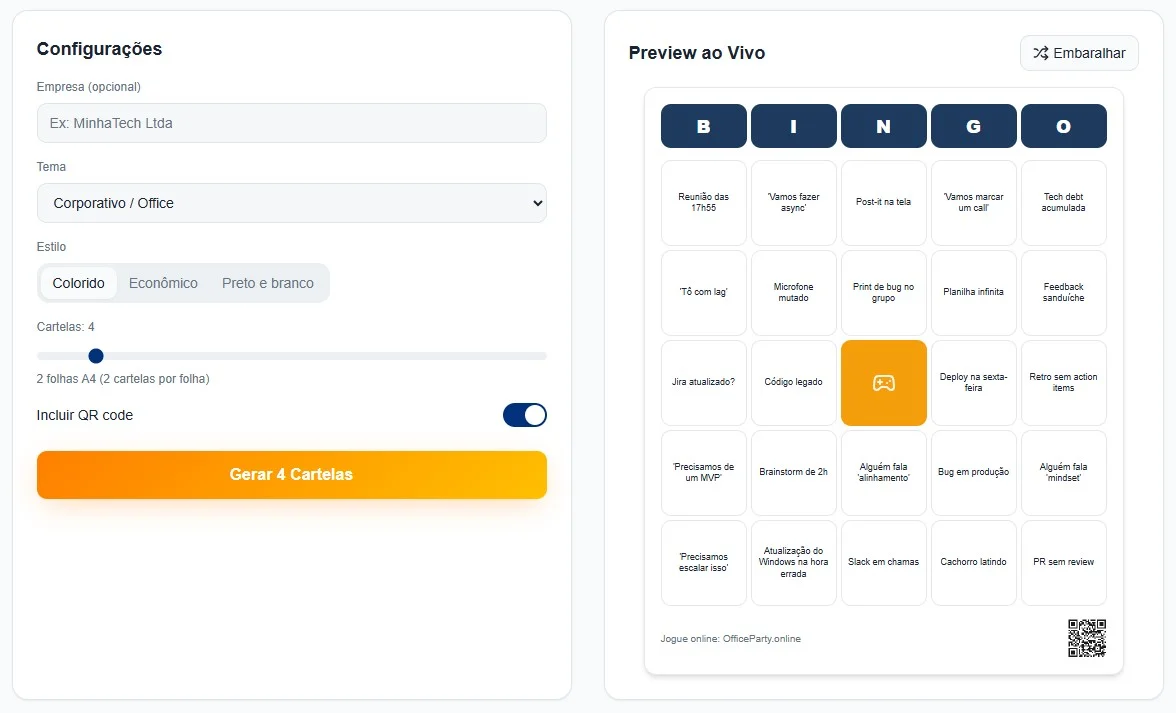
How the generator works (OfficeParty)
In OfficeParty's bingo generator, you enter the list of items (or challenges), define how many cards you need and generate a file ready to print or share. The proposal is to reduce manual work and let you focus on what matters: facilitating the dynamics, moderating time and ensuring that the game is aligned with the objective (integration, celebration, recognition or learning).
PDF export formats and options
To print without headaches, prefer to export as PDF and standardize the layout.
Good format practices:
- PDF in A4 for common printing (HR, office, coworking).
- Comfortable margins to avoid cropping content on simple printers.
- Single page cards (easier to distribute and check).
- High contrast versions when the audience includes people with low vision.
If you want to combine it with other dynamics, it's worth exploring the offline games page to maintain the same standard of materials and preparation.
How to create personalized cards
Personalized cards are what transforms a generic bingo into a team building tool: you choose items that generate relevant conversations, reinforce culture and fit into the meeting time. The golden rule: each box must be clearly “markable”, either by observation (e.g.: “someone mentions a hobby”) or by action (e.g.: “introduce your pet on camera”).
Practical step by step to customize
First define the objective (e.g. encourage feedback, learning, help between areas) and list 3–5 behaviors that generate coins. Then choose a name, visual identity, simple earning/using rules, and limits to avoid inflation or unfairness. Finally, test for 2–4 weeks with a pilot group, adjust the rules based on what happens, and then scale.
Theme and content ideas for teams
Well-chosen topics increase engagement because they provide context and reduce the anxiety of “not knowing what to say”. Examples that work well: Onboarding Bingo (roles, tools and key people), Culture Bingo (values in actions), Quarterly Achievements Bingo (learnings and victories), Interests Bingo (hobbies, music, sports), Collaboration Bingo ("helped someone", "asked for help", "did pairing"), and Retrospective Bingo ("something that improved", "something to test").
For remote meetings, combine it with a light ritual (5 minutes warm-up) and, if it makes sense, connect with other blog ideas such as Virtual happy hour: complete guide for engagement and team building.
Game variations and ready-made scripts
Having clear variations helps keep the game inclusive and aligned with the time available. The same card can be used in 10, 20 or 45 minute itineraries, changing only the way of scoring, the victory condition and the role of the facilitator (more driven or freer).
Competitive, cooperative and hybrid versions
In the competitive version, people or teams accumulate coins and compete for rankings and prizes, which can accelerate results, but requires care not to encourage a “numbers game”. In the cooperative, collective goals release rewards for everyone, strengthening collaboration and reducing rivalry. The hybrid combines both: it encourages individual performance with team mechanisms (bonuses for helping, shared goals) to balance merit and culture.
Recommended offline games (link to games)
If you are putting together an activity kit for in-person or hybrid events, it is worth combining bingo with other options that are simple to print and facilitate. OfficeParty brings together several alternatives on the offline games page, useful for creating a “grid” of dynamics (opening, middle and ending) without depending on complex setups.
Practical tips to maximize engagement
Engagement doesn't just come from the game, it comes from facilitation. Combine short rules, well-defined timing and a clear “why” (what the team gains from it). For recurring encounters, rotate themes and maintain a repository: this creates continuity and improves the experience over time. If you want to complement it with other digital options, you can explore the online games section to vary formats depending on the team's moment.
How to integrate awards and recognition
Prizes work best when they reinforce the desired behavior (collaboration, curiosity, acceptance) and not just “speed”. Simple options: coffee voucher, featured on the team's channel, choose the next playlist, or a fun “title” (e.g.: Collaboration Ambassador). To avoid excessive competition, use categories: “top notch,” “best story,” “greatest help to someone else,” and “team spirit.”
Measuring impact and participant feedback
Track before/after metrics, such as participation in rituals, volume of recognition, collaboration between areas and climate indicators (eNPS/pulses). Combine quantitative data with short qualitative feedback (2–3 questions) to understand perceptions of fairness, clarity, and motivation. Review rules and rewards monthly, looking for signs of distortion (excessive accumulation, cliques, low adherence) and iterating transparently.
Frequently Asked Questions (FAQ)
Below are common questions from those who want to use printable bingo for team building, engagement and remote games, including tips for customization, printing and facilitation.
How to create different bingo cards for each person?+
Use a generator that automatically varies the position of items on each card. You prepare a base list (words, challenges or affirmations) and define the number of cards; the system creates unique versions and exports to PDF to print or share.
What is the best card size for team building (e.g.: 3x3, 4x4, 5x5)?+
For short encounters (10–15 min), 3x3 or 4x4 usually works best because progress is rapid. For 20–45 min sessions or asynchronous games, 5x5 allows for more variety and conversations without “ending too soon.” font-semibold hover:bg-muted/50 transition-colors list-none [&::-webkit-details-marker]:hidden">Can you use bingo for remote games without printing?+
Yes. Send the PDF in chat/email and allow digital marking (note on cell phone, PDF tool, or simply register the marked houses in chat). Another alternative is to play in pairs: one person shares the screen/card and the other helps validate the marks.
How to avoid embarrassing items or items that reduce participation? class="faq-minus hidden">−
Prefer light and optional items, avoid sensitive topics (health, politics, religion, finance) and offer alternative paths of participation (chat instead of speech, peer validation, “pass” without penalty). Test the card with 1–2 people before the event.
What is the best way to reward without creating negative competition?+
Use multiple recognition categories (e.g., collaboration, best story, supporting someone else) and combine symbolic awards with positive visibility. In teams that prefer less competition, adopt cooperative mode: the group tries to complete the card together.
About the author

Ayrlonn Galvão
Eu sou o Ayrlonn Galvão, apaixonado por tecnologia e cultura organizacional. Criei o OfficeParty.online para ser a ferramenta que eu mesmo gostaria de ter usado em minhas equipes remotas: algo simples, divertido e que realmente une as pessoas. Meu objetivo é ajudar você a construir um time que, além de performar, se diverte junto.